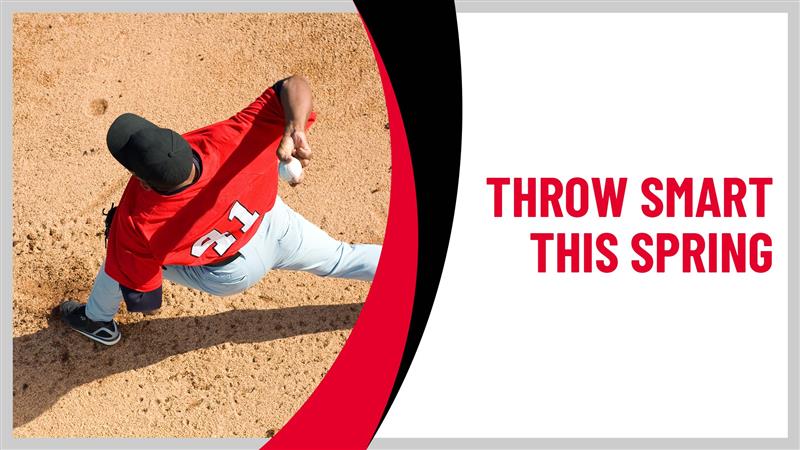
Early spring is when many baseball and softball players ramp up their throwing intensity after an offseason. That rapid increase in workload is one of the biggest reasons throwing injuries spike at the start of the season. Whether you are a youth player, high school athlete, recreational adult, or professional competitor, your shoulder and elbow need time to rebuild tolerance. This guide explains what commonly gets injured, what early warning signs to watch for, and how to prevent throwing injuries before they derail your season.
Reviewed and contributions made by Upper Extremity Fellowship Director Daniel Kline, DPT, SCS, ATC
Key Takeaways
- Throwing injuries often happen when intensity or volume increases too quickly.
- Shoulder and elbow soreness and pain are common early warning signs in baseball and softball.
- Gradual ramp-up, smart workload management, and proper warm-ups reduce injury risk.
- For throwing pain that lingers or changes, it is recommended to evaluate the athlete’s mechanics.
- In most cases, no doctor’s referral is needed to begin care at ATI Physical Therapy.
Why Early Spring Throwers Get Hurt
Throwing is a high-speed, high-force motion that places repeated stress on the shoulder and elbow. During early spring, many athletes move quickly from minimal offseason throwing to practices, tryouts, bullpens, long toss, and games.
Even if you stayed active over the winter, your throwing arm may not be conditioned for repetitive overhead stress. Cold temperatures, tight muscles, and early-season enthusiasm often combine to increase injury risk. The solution is not avoiding throwing; it is progressing workload safely, so tissues adapt instead of breaking down.
By the Numbers: Baseball and Softball Throwing Injuries
These numbers show how common throwing injuries are across age levels, from youth leagues to professional baseball.
- Research suggests that about 30 percent of youth baseball players experience elbow pain each year, and risk rises with high workloads like playing many games per year (National Institutes of Health).
- In a 10-year study of youth pitchers, the cumulative incidence of serious arm injury was 5 percent, and athletes who pitched more than 100 innings in a year were 3.5 times more likely to be injured (National Institutes of Health).
- In a Major League Baseball injury epidemiology analysis, upper extremity injuries accounted for 51.4 percent of all player injuries, highlighting the heavy stress placed on shoulders and elbows at the professional baseball level (Penn State University).
Together, these findings reinforce one consistent theme across levels: workload matters.
If you or a loved one is experiencing shoulder pain, elbow pain, or recurring soreness from throwing, come to ATI Physical Therapy for an initial evaluation with a licensed physical therapist. We will build a personalized plan around your needs. In most cases, no doctor’s referral is needed to begin care.
What Hurts Most in Baseball and Softball
Throwing injuries often begin subtly. Mild soreness may feel manageable at first, but pain that lingers, sharpens, or alters mechanics can signal overload. The most common problem areas include the shoulder, elbow, forearm, and, in softball pitchers, the hips and trunk.
Shoulder Pain From Throwing
Shoulder pain is frequently related to rotator cuff overload, shoulder blade fatigue, or limited mobility. Some athletes feel pain in the front of the shoulder, others feel it deep inside or along the outside.
Common Causes
- Sudden increase in throwing volume or velocity
- Fatigue of shoulder stabilizers
- Limited mobility in the shoulder, upper back, or hips
Common symptoms
- Ache during or after throwing
- Pain lifting the arm overhead
- Reduced velocity or control
How PT can help
- Structured return-to-throw progressions
- Rotator cuff and scapular strengthening
- Mobility work for shoulder and thoracic spine
- Mechanics assessment
When to see a PT
- Pain lasts more than a few days
- You feel weakness or instability
- You notice a dead-arm sensation
Elbow Pain in Throwers
Elbow pain often appears along the inner elbow, where the UCL supports high-speed throwing. It may also appear laterally depending on mechanics and fatigue.
Common causes
- High workloads without recovery
- Throwing too hard too quickly
- Mechanics breakdown from fatigue
Common symptoms
- Tenderness on the inside of the elbow
- Sharp pain during acceleration or release
- Stiffness the next day
How PT can help
- Workload modification
- Forearm, shoulder, and core strengthening
- Mobility training for hips and trunk
- Return-to-throw programming
When to see a PT
- Pain persists beyond normal soreness
- Sudden sharp pain or pop
- Tingling, numbness, or weakness
Forearm and Wrist Overuse
Grip-heavy throwing and batting can overload forearm tissues, especially when the shoulder is fatigued.
Common causes
- Repetitive throwing without rest
- Over-gripping
- Compensation from shoulder fatigue
How PT can help
- Progressive strengthening
- Throwing efficiency coaching
- Recovery and workload planning
Softball Pitching Considerations
The windmill motion still places stress on the shoulder, elbow, hip, and lower back. Tournament weekends and high pitch counts increase fatigue risk.
How PT can help
- Shoulder and trunk endurance training
- Hip mobility and glute strength
- Recovery planning
How to Prevent Early Season Throwing Injuries
Prevention centers on gradual progression and movement quality.
Build a Throwing Ramp-Up
Increase volume and intensity slowly and step by step. Avoid jumping directly into high-effort throws.
Warm Up Thoroughly
Include full-body movement, shoulder muscle activation, and light throwing progressions.
Respect Workload Guidelines
Track pitches, innings, or total throws. Rest days matter at every level.
Train the Entire Body
Strong hips and trunk reduce stress on the arm.
Do Not Throw Through Pain
Persistent or sharp pain should not be ignored.
At-Home Thrower Warm-Up and Mobility Routine
This routine supports shoulder and elbow readiness. Stop if pain increases.
How often
Before throwing: 1 time; on non-throw days: 2 to 3 times per week
Arm Circles and Shoulder Blade Squeezes
- 10 forward, 10 backward
- 2 sets of 10 squeezes, hold 2 seconds
Band External Rotation
- 2 sets of 10 to 12 reps per side
Wall Slides
- 2 sets of 8 to 10 reps
Thoracic Rotation
- 5 reps per side, hold 2 to 3 seconds
Hip Flexor Stretch
- Hold 20 to 30 seconds per side
- Repeat 2 times
When to See a Physical Therapist
If you or a loved one is experiencing shoulder pain, elbow pain, or recurring soreness from throwing, come to ATI Physical Therapy for an initial evaluation with a licensed physical therapist. We will build a personalized plan around your needs. In most cases, no doctor’s referral is needed to begin care.
Ready to take the next step?
Book an Evaluation Today
Frequently Asked Questions
Is early-season arm soreness normal?
Mild muscle soreness can occur, but persistent or sharp pain is not typical and should be evaluated.
What is the most common throwing injury?
Shoulder and elbow overuse injuries are among the most common in baseball and softball.
Can physical therapy help prevent throwing injuries?
Yes. PT can improve strength, mobility, mechanics, and workload planning.