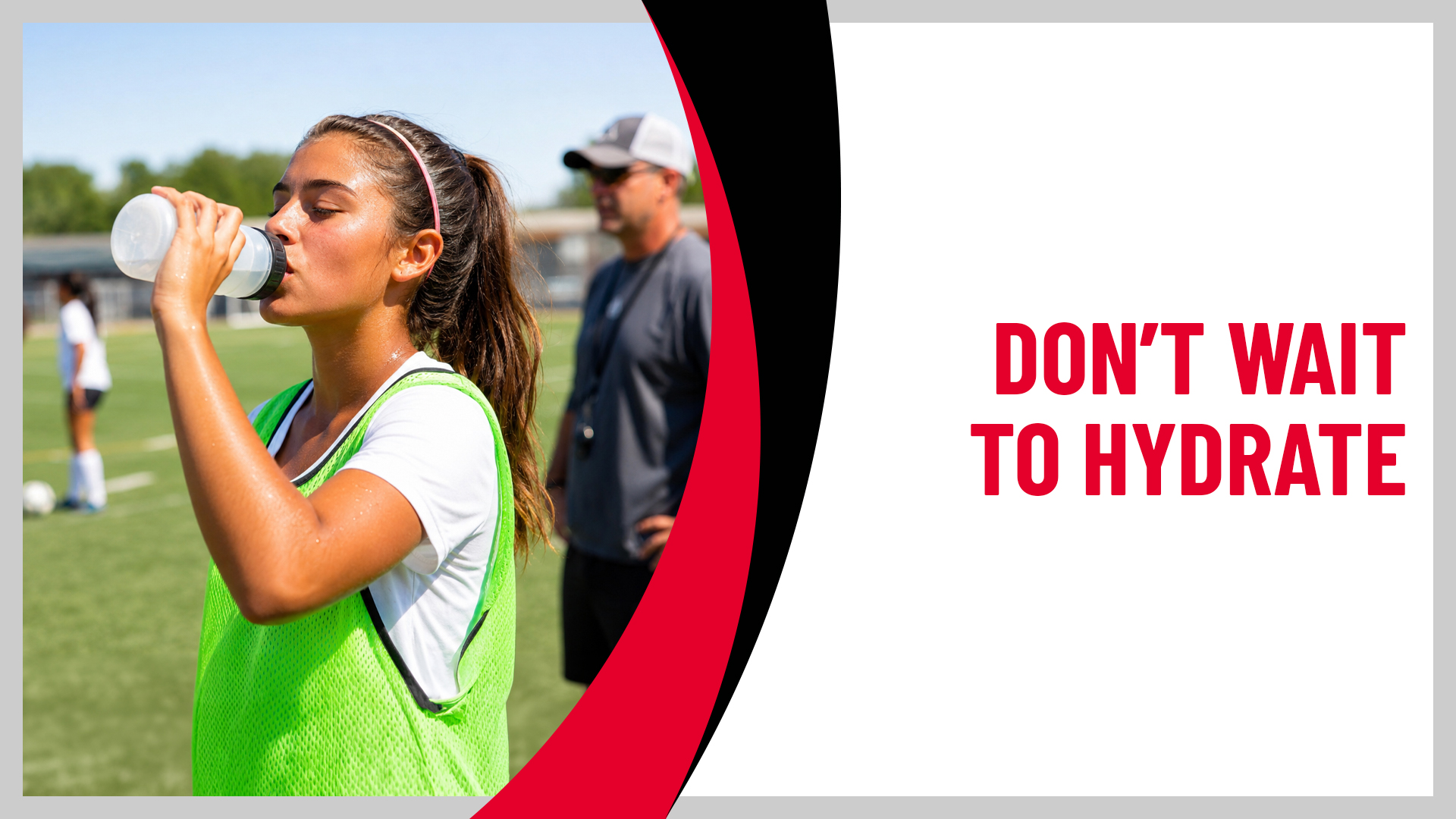
Every summer, I see the same thing on fields, courts, and in weight rooms. An athlete goes down. Not from contact or injury, but from something entirely preventable: dehydration.
After 15 years as an Athletic Trainer, including many long, hot summers with high school athletes, I can tell you this is one of the most common and avoidable issues we face.
About the Author: Written by Patrick Roscoe, MS, LAT, ATC, a licensed Athletic Trainer with 15 years of clinical experience helping athletes stay healthy, perform at their best, and safely return to play.
Your body is already behind when you feel thirsty
Here’s the big takeaway: if you feel thirsty, you are already playing catch up.
Thirst kicks in after you have already lost about 1 to 2 percent of your body weight in fluid. For many athletes, that can happen in less than one half of practice. At that point, performance is already slipping. Endurance drops, focus fades, and reaction time slows.
Your body does not send a loud alarm. It sends a quiet signal. The goal is to stay ahead of it.
What is really happening when you sweat
Sweat is not just water. You are also losing key electrolytes like sodium, potassium and chloride that help your muscles and nerves function.
When those are not replaced, problems start to build quickly. Blood volume drops. Heart rate rises. Your body struggles to cool itself. Core temperature climbs. That is when heat illness becomes a real risk.
This is even more common when athletes jump into intense summer workouts without easing in, wear heavy equipment, or practice in humid conditions. It takes about 10 to 14 days for the body to adjust to exercising in the heat.
Catching the warning signs early
Heat illness rarely starts with a collapse. There are early signs that are easy to miss.
- Muscle cramps are often the first signal. They are painful and usually tied to fluid and electrolyte loss.
- Heat exhaustion is more serious. Look for heavy sweating, weakness, nausea, dizziness, and a fast pulse. If this happens, the athlete needs to stop, cool down, and rehydrate right away.
- Heat stroke is an emergency. Confusion, loss of consciousness, and very high body temperature are major red flags. This requires immediate medical attention.
What good hydration actually looks like
Hydration is not complicated, but it does take intention.
Before activity, drink about 16 to 20 ounces in the couple of hours leading up to practice. A simple check is urine color. Pale yellow usually means you are in good shape.
During activity, aim for 6 to 8 ounces every 15 to 20 minutes. If you are going longer than an hour in the heat, you need electrolytes, not just water.
After activity, replace what you lost. For every pound of body weight dropped during practice, drink about 16 to 24 ounces.
And one of the most overlooked pieces: good hydration starts before practice. If you go to bed dehydrated and wake up that way, you are already behind before the first drill.
Why having an Athletic Trainer matters
A good Athletic Trainer is not just there for injuries. We are watching for risk before it becomes a problem.
We track heat conditions, adjust activity when needed, and spot early symptoms athletes might ignore. Most athletes want to push through. They are trying to prove themselves. But knowing when to speak up is part of being a smart athlete.
Three simple habits for a safer, better summer
- Start practice already hydrated.
- Drink on a schedule, not just when you feel thirsty.
- Speak up if something feels off, like cramps, dizziness, or nausea.
Summer is when athletes work the hardest, but it is also when risk is highest. The good news is that one of the best performance tools is also the simplest.
Drink early. Drink often. Pay attention to your body.
Patrick Roscoe, MS, LAT, ATC, is a University Recruitment Advisor with ATI Physical Therapy and a licensed Athletic Trainer with 15 years of clinical experience. He works with Athletic Training students and university programs nationwide, connecting the next generation of ATs with career opportunities across ATI’s Sports Medicine and Worksite Solutions divisions.